
December 29 and we are at LHR on our way to Jerez de la Frontera to start our stay in southern Spain. It had to be better than January, February, and March in the UK – right?Did not start well as there were control tower issues delaying flights, including ours. The 2 hour delay meant we missed our connection in Madrid resulting in our eating and drinking in the business class lounge in London for 2 hours, Madrid for 4 hours, and getting to our hotel at 11.30 pm. I called the hotel to let them know we were going to be really late, but they were sweet and told us not too worry, our room would be waiting for us. So not all bad.
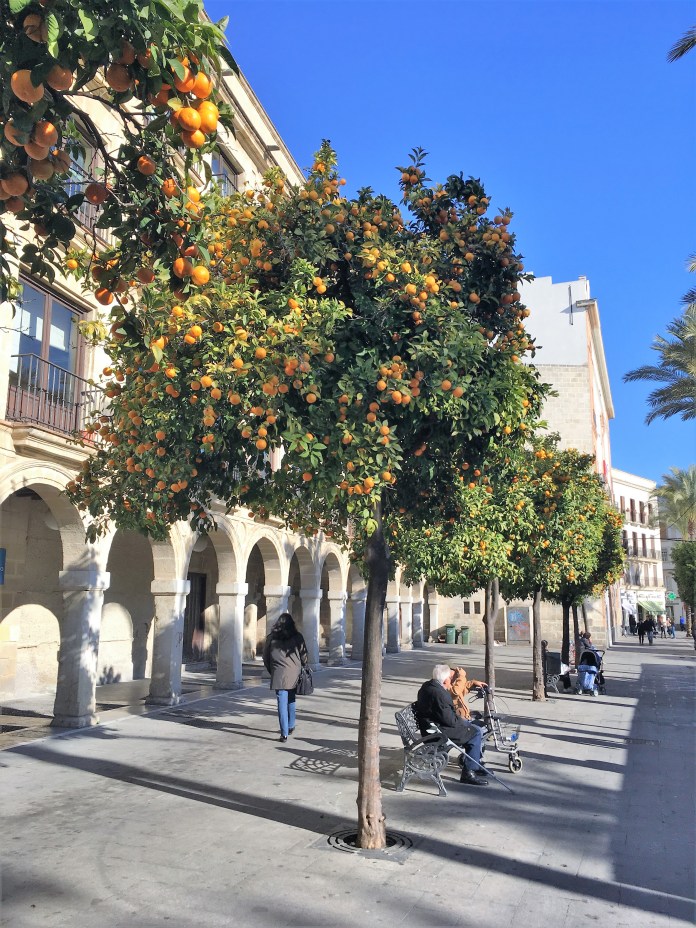
Plaza del Arenal, Jerez.
After a good night’s sleep and a really good breakfast at our hotel, it was off exploring Jerez. It was a beautiful day – about 16C and sunny – and we both agreed this was the sort of winter we liked! Jerez is a big sprawling city with a population of about 220,000, but like most European cities still has the old centre packed with all sorts of historical stuff and is a joy to wander around gazing at the old buildings. Our hotel was just off Plaza del Arenal so we could walk to everything, and had a number of good restaurants within a few minutes of the hotel. The Spaniards take winter seriously and there was a plethora of fur coats, suede jackets, scarfs and hats. The street life was immensely entertaining with the bars and cafes busy with people eating and drinking out on the street, while the bakeries and pastellerias were doing a roaring trade. All very European and so much more colourful than the UK. After checking out the exterior of the cathedral we were faced with the walls of Bodega Tio Pepe so we followed the wall until we found the entrance – a big place. All tours, of course, so we selected a tour that was followed by a tasting of their sherries. Our tour was in English and German and as a result took twice as long as it should, plus all the silly questions that are asked. It appears people actually do not engage brain before they open their mouths! The Bodega is huge and there are little trolley car trains taking you from building to building. There are thousands of casks stacked 4 high in the solera system of making sherry, with the bottom cask being where the wine is taken to bottle, but only 30%. This is then topped up from the layer of casks above until you get to the top layer where the new wine is put. Amazing smell from the barrels and sherry, plus to see them sample the wine with a thief and tip it into a sherry glass is brilliant. Wonder how many gallons of sherry end up on the floor before they master the process?
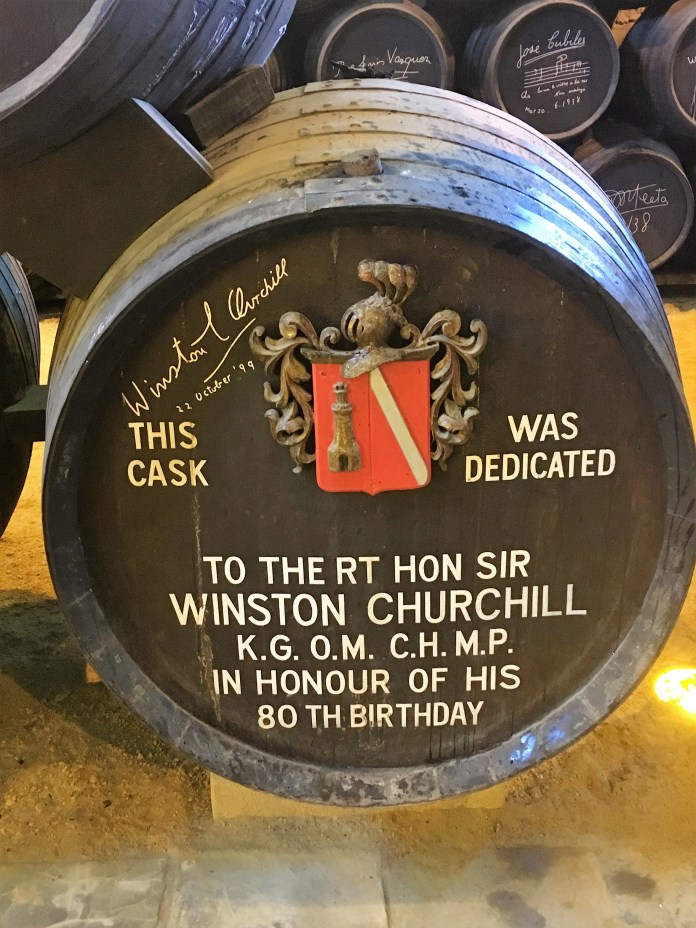
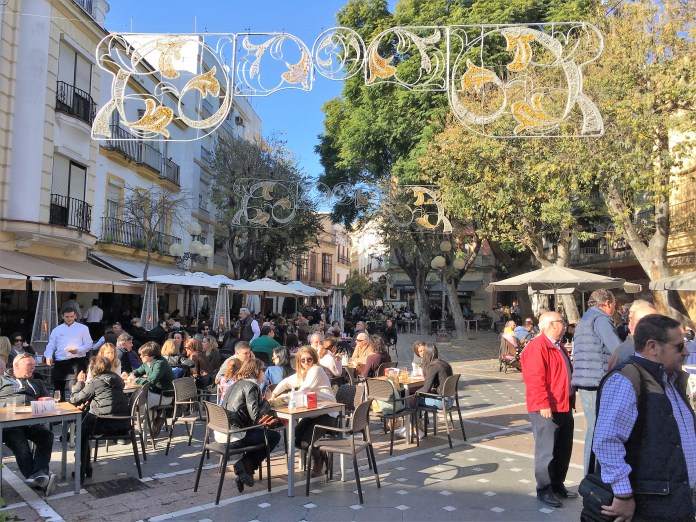
One in a series of cellars was where there were casks put down for royalty and celebrities including The Queen and Winston Churchill. Not impressed with the tasting – both the service and the wines. Their fino is quite good, but that’s it! Just as well we liked the fino as it turned out to be the standard pouring brand for 90% of the bars and restaurants we visited while in Spain. Somebody is doing a good marketing job! After that it was lunch – about 1.30 pm – comparatively early for the Spaniards, but it did mean we didn’t have to fight for a table. We ate at a Tapas Bar called La Cruz Blanca on a small square which was also a busy pedestrian area; what a great start to Andalucian food! Sitting in the square sipping our cana (small draft beer) while eating mixed fried fish, ox tail, and croquettes. Super food in the sun after a sherry tasting – we like Spain!
The only down side was our timing as we were now at the start of the New Years weekend and a lot of places were closed, so we made no attempt to go out on New Years Eve and stayed in our room with some ham, sausage, a selection of cheeses, sherry, and a 20 year Spanish brandy for dessert. Watched the New Year in on Spanish TV’s coverage of the early spots like NZ and Aus before going to bed to sleep in the New Year. Not that dissimilar to seeing in 2016 in our hotel room in Palm Desert, CA with PF Chang’s take out. Hey, it’s the oldies good life! January 1 was our final night in Jerez and we celebrated by dining at La Carbona a 1* Michelin restaurant in an old sherry warehouse in the back streets of town. An amazing meal with the highlight being their steak tartare, made from local Retinto beef, washed down with a bottle of local wine – Taberner Merlot/Syrah blend running at 15.5% – a huge wine. Dessert was glasses of 30-year-old Noe Pedro Ximenez! The wine was so dark it was black and had a lovely dry finish – a totally stunning wine. This Spain thing was just getting better & better.
January 2 we took a taxi out to the airport and picked up our car from Mr Hertz. Super lady who gave us an upgrade and would you believe full insurance cover at a half-assed reasonable rate – which we took. We had received detailed driving instructions from Gary Biston, the owner/manager of our villa, which conflicted with Elsie the GPS; so we went with Gary’s. Proved to be accurate but still missed the tiny road off the N-340 that goes to Santa Lucia.
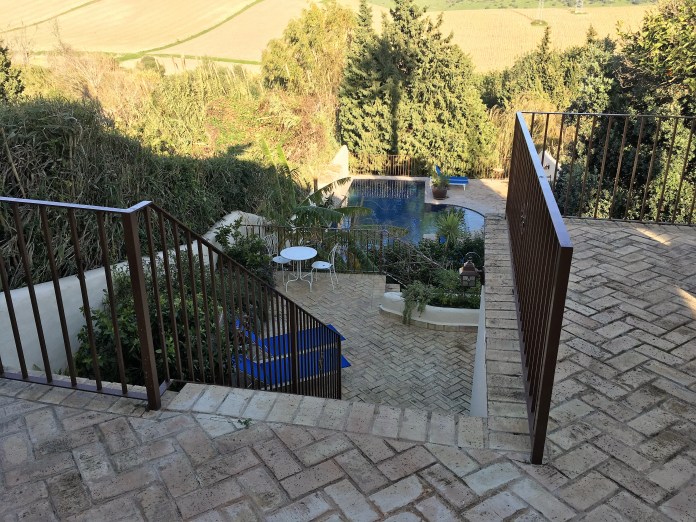
Casa Lucia.
Anyway, made it to Casa Lucia, found the keys, and unloaded/unpacked and settled in to our home for the next 3 months. Santa Lucia is a small village of about 3-400 people that dates back to Roman times and has 3 good restaurants in walking distance of the house. Just across the valley is the town of Vejer del la Frontera, one of the pueblo blancos of the Andalusian coast, and the main reason for picking this area of Spain. The view of Vejer from our villa was spectacular and it was a constant delight to see in the changing light and weather conditions.
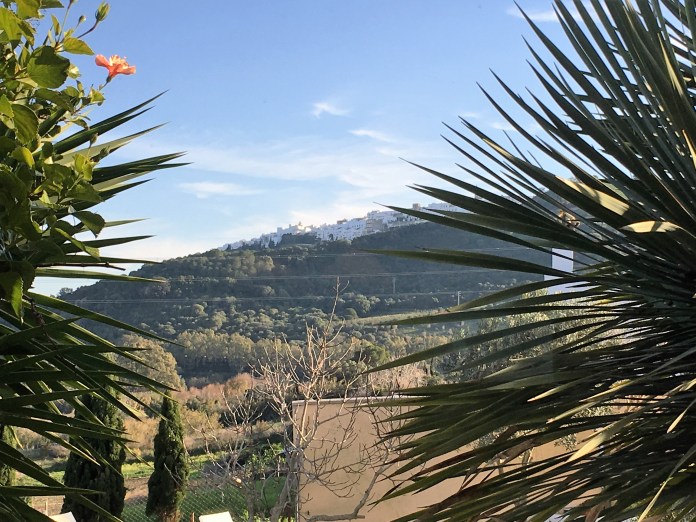
Vejer de la Frontera.
The next day it was off to Barbate, about 7.0Km from Santa Lucia, to get the basics from Lidl and Aldi which became our local supermarkets for the duration. It should be explained that Barbate is one of the Almadraba tuna ports, the drug capital of Andalusia, and Franco’s favourite summer seaside resort. Shall we say a working town rather than a tourist resort. Ann had found a local restaurant for lunch, so we had another early lunch – 1.30/1.45pm – before shopping. It was truly local with construction workers, fireman, and truck drivers packing the place. Ann went with the set lunch because it was paella, but then found out that was just the starter, the main course was fried fish, vegetables and chips. It turned out that Ann’s 3 course set lunch, which included a beer and coffee totalled 9Euros/$10, where as my ala carte order of shrimp fritters, tuna & chips with a couple of beers was double that!
Over the next few days we explored Vejer del la Frontera. It was mostly narrow cobbled streets and lanes most of which dated back to Moorish times, or earlier, and was very much a living town with butchers, bakers, market, bars, and shops that covered just about all needs. In the early days we got lost every time we went into Vejer despite maps and google maps, but it threw up photo ops at every turn so we were happy bunnies!
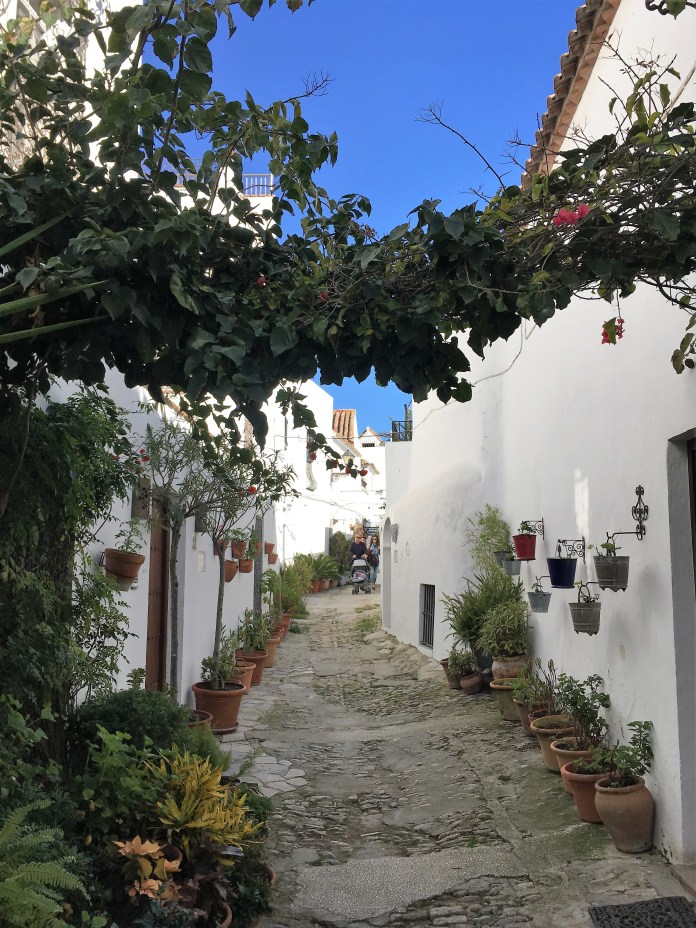
Plus there were restaurants and bars on every street. Surrounding the north east of the old walled city was the modern portion of Vejer, where the post office, hospital, and sports centre was located. We located the swimming pool for Ann but found out they just swam, no water aerobics. We also found the local gym, a small facility that was closed on our first visit, and the manager/receptionist was not in attendance on our next 2 visits. Found out from an older gentleman at the gym that the person in charge basically opened up and then disappeared to the local coffee shops. Guess what, we never joined! However, we did sign up for a 1 week immersion course of Spanish at La Janda language school in the old town. So each morning for a week we parked in the main car park at the entrance of the town and hiked up the hill and through the tiny back streets to La Janda for our lessons with Professor Maria. What a delightful, funny, informative teacher she was, and we loved our lessons. She covered the basics of what we needed for our stay in Spain and we finished with a 3% proficiency in Spanish; all most fluent! It really did help and made life that much easier. Plus Google Translate with its photo application meant that we could decipher most things, though some of the English translation often had us puzzled!
When visiting Fran on our Norfolk trip we mentioned that we had a 3bed/3bath villa on the Costa del Luz and she was welcome to stay. Anyway, the initial few days moved to a week, and then 2 weeks as Fran worked out there was so much she needed to see! Fran came through Madrid to Jerez without a hitch and we had her picked up by Malolo, aka Lolo, Gary’s driver/maintenance/fix-it man. Lolo is one of life’s good guys – charming, always smiling, and would do anything for you. Just super! We introduced Fran to Vejer, and Correderra 55, a super restaurant managed by a fabulous Scottish lady, Elly. Then it was off to Cadiz for a few days. One of Fran’s must see places, which was also on our list. We stayed at the Hotel Argantonio, bang in the centre of the old town. Getting through the extremely narrow streets was an experience, but we it made OK, and then blocked the lane while unloaded our bags. We’d picked the hotel because it had parking, which turned out to a tiny underground garage across from the hotel. A lady from reception was sent to open the doors and direct me to our slot. The entrance was so steep and narrow that even after backing and froing I scrapped the front getting in! (glad we had that Hertz insurance) Then getting into our designated slot took another 5 mins of shunting to fit in between pillars and other cars. Had to grin at the thought of a standard American vehicle doing the same thing!
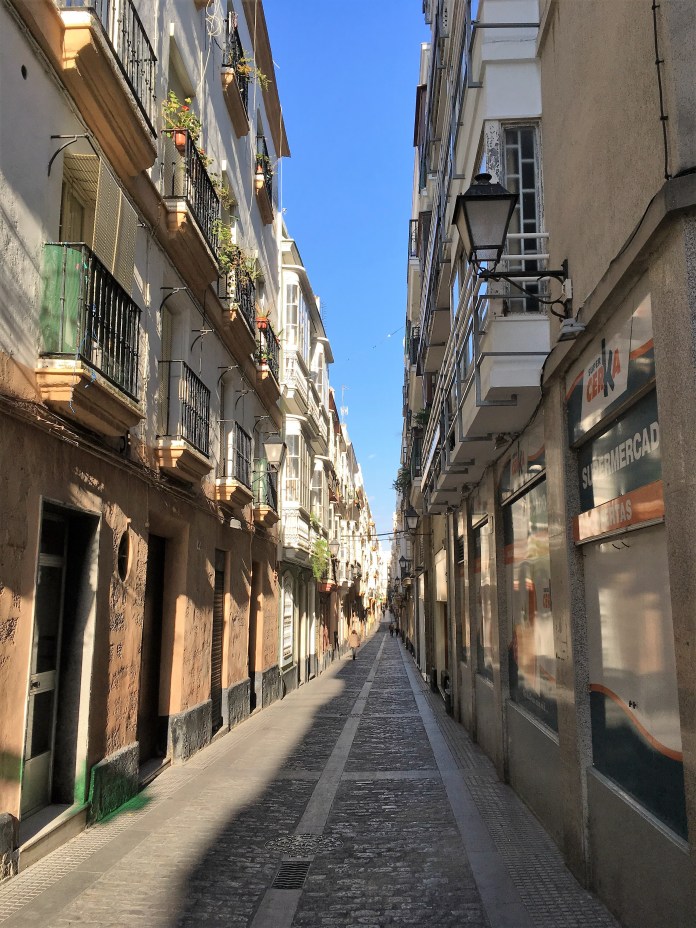
Hotel Agantonio down on the left.
It was then off to walk the old city! Navigator-in-chief Ann had the 1 1/2 hour walk that would cover the highlights of old Cadiz mapped out so off we went. First it was lunch at a local restaurant recommended by Gary. Black foot Jamon hanging from the rafters and packed with locals – we were the only foreigners – always a good sign. Fabulous garlic prawns, and ham with sauteed potatoes – all at a great price!

Cadiz.
The walking tour took something over 2 hours while we took photos and soaked in 5000 years of history. A short rest at the hotel and then it was off to Atxuri a Basque restaurant that was rated as one Cadiz’s best and had been in existence since the early 1900s. Didn’t open till 9.00pm which had Fran chuntering a bit, but the food was amazing. Fishcentric, being Basque, and we all had different fish dishes which were fabulous. Some English spoken so we got through the menu and wine list OK. However, one of their specialities, which had been recommended by the receptionist at the hotel when we sorted out directions, was in Spanish and couldn’t be translated. After ordering our main courses we asked our waiter what it was. Turns out it is a pouch of meat found in the throat of a certain fish – clarification obtained! 10 minutes later a dish of this delicacy was brought to our table, compliments of the chef! A super delicious, very delicate meat, in a light sauce – just amazing. Really, really liking Spain and its cuisine!! As we staggered out of the restaurant around 11.00pm the place was really busy with the locals in for dinner. The streets were still busy as we walked back to the hotel with a number of shops still open.
Breakfast in the Hotel Argantonio was where we first encountered one of the standard breakfast dishes of the region – Tomate – grated fresh tomatoes, some times with a little garlic. You pour olive oil on your tostada and then add liberal amounts of tomate – quite delicious. Soon became a favourite of ours that I often made at home. That and Lomo Mentecca makes an outstanding breakfast as far as I’m concerned.
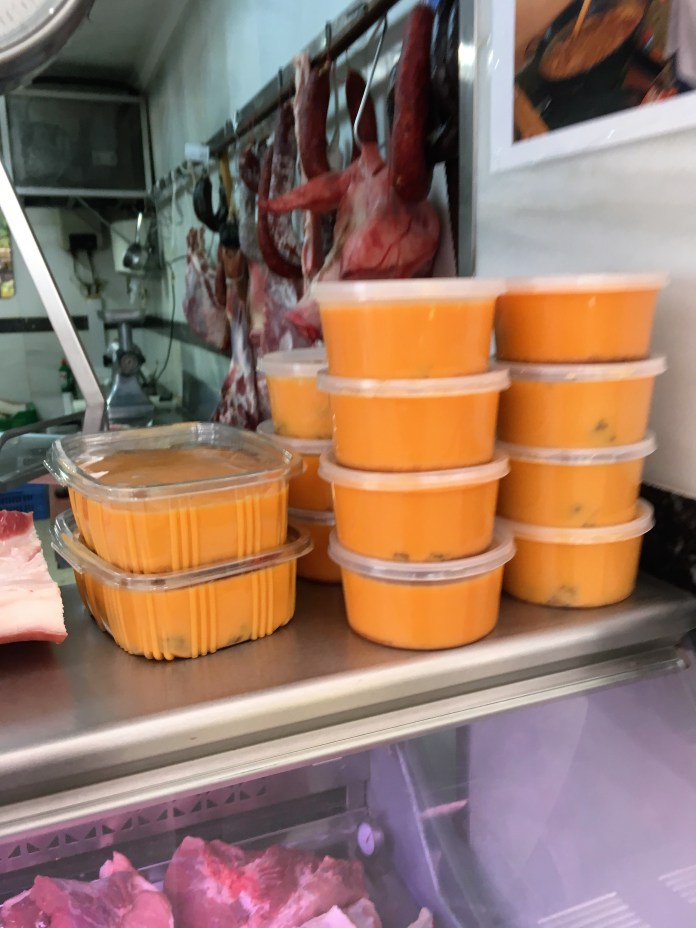
Lomo Mentecca.
Of course I now have to explain what the other Andalusian breakfast delicacy is! It is basically drippings on steroids, and as I grew up with drippings on toast for my breakfast as a young child living with Grandma Kate, it is my sort of food. To make it, you take a rack of Iberico pork ribs and cook with rendered pork fat until the meat falls off the bone then put the meat-fat mixture into tubs and consume. The recipe is made with and without paprika and each butcher’s product is slightly different, but I have to say I did not come across a lomo mentecca I did not like! Should probably mention at this point that southern Spain in not big on seasoning, to the extent you will not even find pepper on the table in restaurants, so most of their food relies on its natural flavours. We found this strange as you could see North Africa from Vejer, and you could be in Tangiers in 3 hours – door to door – by car & ferry from Santa Lucia. However, north African/Moorish food was popular and you found restaurants in all the towns. Go figure as they say.
Back to Cadiz and and our continued exploration of the city. It turned out Fran had had a restless night that involved changing rooms due to smoke alarm lights, and that she was still recovering from our previous days wanderings, so agreed we would meet later. First it was was the Cadiz Museum which was rather a mish-mash with Roman antiquities mixed in with Gothic and modern art, but some stunning Roman gold and glass exhibits. A quick stop at Cafe Royalty for hot chocolate for Ann (well it is winter) and Cafe Cortado for me.
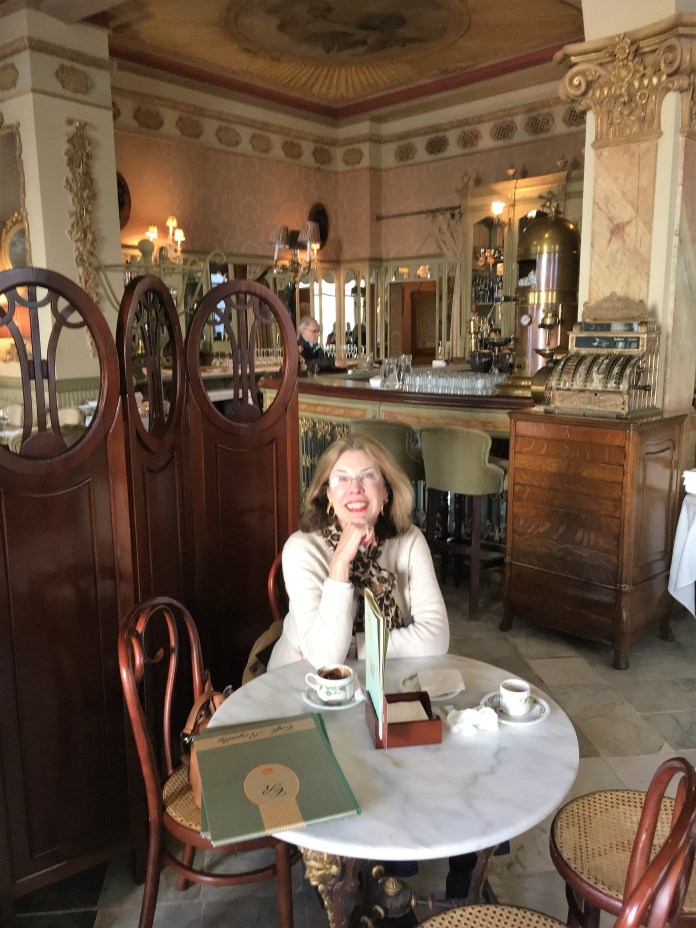
Hot chocolate at Cafe Royalty.
Cafe Royalty is a beautifully restored cafe/restaurant dating back to 1912 – a “grand romantic cafe” of the period does not cover the totally OTT decoration of the place; but it works! Checked out the dinner menus and decided we had found tonight’s eating spot. Then it was on to the cathedral – a baroque monstrosity filled with Catholic bling, a huge organ and lots of saints. Obviously there were construction issues as the whole of the cathedral had nets suspended below the ceiling to catch falling masonry. Almost next door was the Roman museum and excavations complete with a small amphitheatre. Very well done and a fascinating window on the Roman city of Gades. Something there is a lot of in Spain we were soon to find out, but not really a lot of it publicised because there literally is so much of it! Made the mistake of grabbing lunch in Plaza San Antonio, Cadiz’s main square, and a beautiful spot to sit and watch the world, but obviously geared to the tourist trade and the worst meal we had in Spain – by far! Then we found the small Oratorio de La Santa Cueva, tucked in the back streets near our hotel, which is renowned for the three Goya panels in its upper chapel – almost overpowering in such a small space. Then back to the hotel to get ready for dinner! Found Fran who was still exhausted and would not join us for dinner. 8.30-8.45pm saw us back at Cafe Royalty for an early dinner! We had the choice of the formal dining room or the tapas/cafe area, but the cafe was doing a roaring trade so the Maitre ‘D asked us to wait at the bar for a table. We perched at the bar with finos admiring the murals, paintings, and watching the patrons – just super. Two sherries in and we had a table. Had 3 tapas dishes that were all amazing and moved from fino to manzilla through the meal. Shared desert with Irish Coffees decaffinato to round off dinner. One of the best meals and the most fun we had in Spain.
The next day it was back to Santa Lucia, but on the coast road via Cape Trafalgar and Barbate so Fran could see something of the sea and beaches of the Costa del Luz. Beautiful day and Cape Trafalgar was stunning!
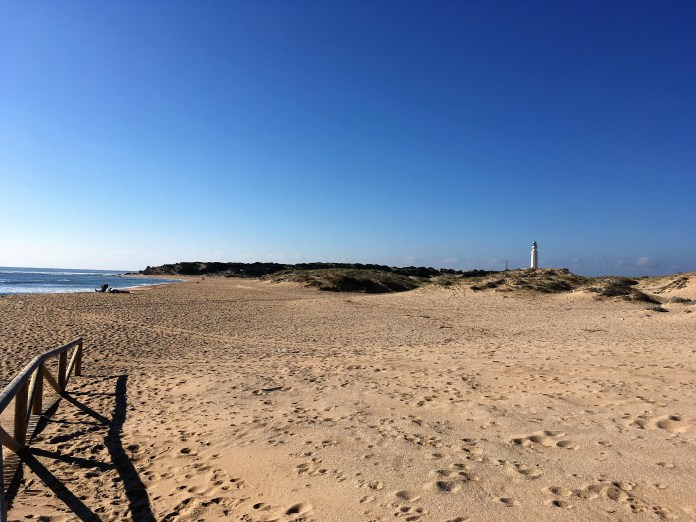
Cape Trafalgar.
Surprised at the lack of information on the Battle of Trafalgar and Admiral Nelson – must hold a grudge! The restaurant we planned to have lunch in in Barbate was closed for some reason – really unusual as every restaurant in Spain is open for Sunday lunch, but it was January? While standing around on the beach front discussing what to do an attractive girl sitting near by told of us of another restaurant further along that was OK. Her immaculate American was to do that she now lived in the States and was back home on holiday – just love the world’s travelling population. Anyway, sat outside in the sun and watched Barbate’s families eat and play. OK food, better than our tourist trap in Cadiz but with the portion size and price you couldn’t really complain. Then on-on to Santa Lucia so Fran could re-pack and catch the 7.00am bus to Seville, with Lolo driving her to La Barca de Vejer bus stop.
We knew Andalucia was going to be pig heaven because of the Iberico black footed pigs that are traditionally fed on acorns. What we did not know was the Costa del Luz was the world centre for tuna, and still has 5 almadraba fishing ports that catch the migrating tuna in a net system dating back thousands of years. Shops and restaurants have charts showing the cuts of tuna and you literally purchase the cut you want – belly, loin, head, etc. Tuna is packed in jars and tins with olive oil and bears no resemblance what so ever to the tinned tuna found in England and the US. Just after we arrived a tuna caught in Barbate was air freighted to Japan and sold at auction in the Tokyo fish market for $500,000.00!! Our cost of fresh and preserved tuna was very reasonable to say the least and we did eat a lot of it. One of the tuna specialities we came across was cured/dried tuna loin which came in foil vacuum packs. This thinly sliced and eaten with a glass of manzanilla turned out to be a super new eating experience. While on this steep tuna learning curve we headed off to Zahara de la Atuna, a small coastal village about 30Km from Santa Lucia, and the heart and soul of Spain’s tuna industry for over a 1000 years. It still has the remains of a castle built in the 10thC which was constructed to protect their tuna fishing and to process the tuna for shipment to other parts of Spain.
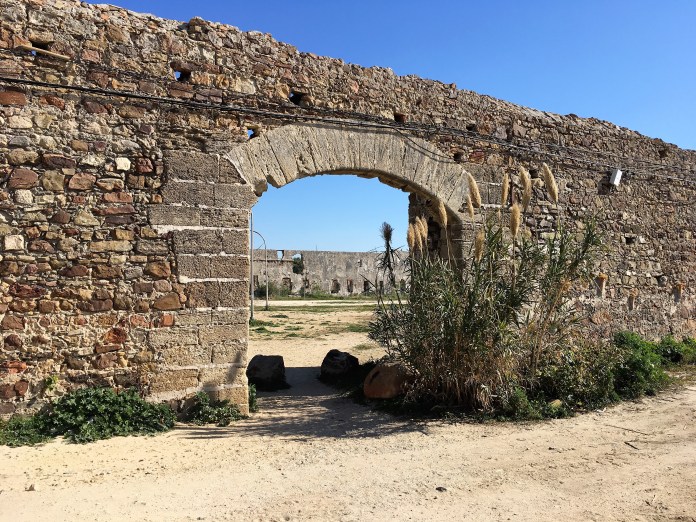
Castillo de las Almadrabas.
Typical of “old stuff” in Spain this was not considered to be of any note and was not even sign posted in any shape or form. We actually identified the site after driving all around town and finding a couple of ancient walls right next to the church. We parked and walked through and old gateway into an open area about 200 metres square that had walls in various states of disrepair, complete with a group of ruined buildings which now appear to be the local disco! We walked straight through and out onto the beach where the tuna was once brought in for processing, but is a now a mass of villas and hotels. Only one restaurant in town was open, but they did very good food. Fish soup and a plate of mixed cuts of grilled tuna, with of course a few glasses of sherry.
Had a farewell lunch for Fran at La Tejea, one of our local village restaurants. Their terrace is fabulous with great views across the valley to Vejer, and really good food. Minimal English, but with our amazing Spanish and Google Translate we always have fun as well as good food. Carpaccio seemed to be the dish of the day as Fran had Gambas Carpaccio while I had Carpaccio de Pulpo – yep, octopus carpaccio! It was amazing and another first on my food list – I mean how do you get to 74 and still find dishes you have never, ever, tried?! Anyway, a great meal rounded off by Ann asking for a doggy bag in her immaculate Spanish to our waiter who looked a little puzzled, but then broke into a broad grin. In English he then asked Ann why she wanted to take a shower?! Hilarious! Ann got her doggy bag without having to take a shower with the waiter.
Fran’s return to the UK brought a close to our first month in southern Spain, as well as some heavy rain. Still beautiful though a little soggy!
 theangryanglo